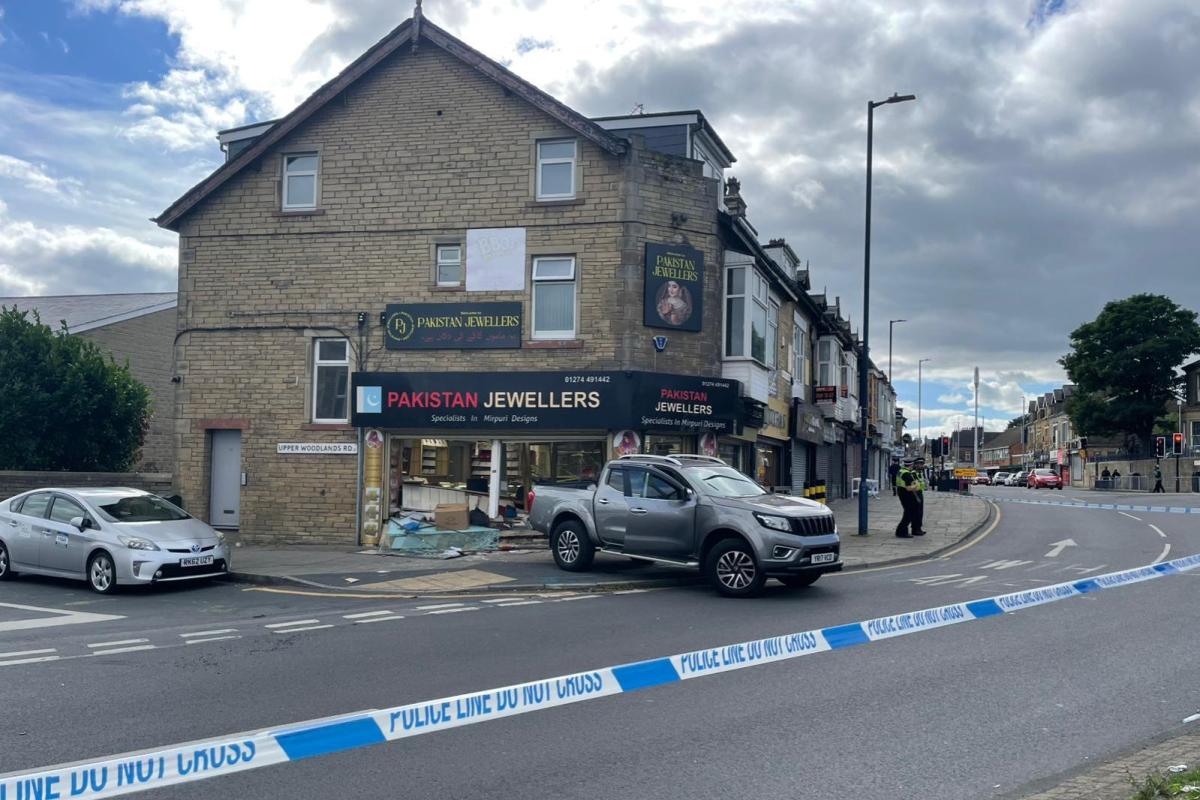
A daylight ram-raid at a Bradford jeweller has brought the physical risks facing high-value retailers into sharp focus, as businesses consider how building design and specialist security systems can protect customers, staff and valuable stock. The incident at Pakistan Jewellers on Duckworth Lane took place at around 1pm on Saturday 5 September, when a vehicle was reversed through the front of the premises while the shop was busy with customers.
CCTV footage subsequently published by the BBC showed customers gathering behind a counter as the vehicle entered the shopfront and a group of masked men entered the premises. The group left shortly afterwards and no stock was taken. One customer sustained minor injuries.
For Birmingham security door manufacturer Warrior Doors, the circumstances demonstrate why protection for jewellers and luxury retailers increasingly extends across the entire frontage and internal layout of a store. Managing Director Brett Barratt said:
“The part that really stands out is that this happened in the middle of the day, with customers and staff inside. A vehicle coming through a shopfront creates an immediate threat to people as well as providing a route towards the stock.
“For retailers carrying jewellery, watches and other high-value goods, security has to be considered as a complete system. Vehicle mitigation, security doors and secure display vaults each have a role within that.”
Stopping the vehicle at the perimeter
Vehicle attacks present a particular engineering challenge because of the combination of mass, speed and impact energy involved. Warrior Doors has developed vehicle mitigation technology specifically for environments where a vehicle could be used to attack an entrance or shopfront. The objective is to create a physical layer capable of protecting the building line and the people beyond it.
For high-value retailers, this can form part of the architectural design of the premises alongside reinforced entrances and specialist glazing.
Barratt said: “The best place to deal with a vehicle attack is at the perimeter. Every metre between the vehicle and the people inside the building matters.
“We manufacture solutions around the way a particular property operates. A jewellery store on a busy high street has a different layout and customer flow to a private residence or commercial building, so the security design needs to reflect the site.”
Creating layers between the street and valuable stock
The same principle continues beyond the external perimeter. Warrior Doors manufactures high-security doors designed to provide substantial physical resistance at entrances and at strategic points within a building. For luxury retail environments, these can form part of controlled entrance arrangements and time-lock or airlock security systems, providing additional layers between the public realm and high-value merchandise.
The company manufactures its security products in Birmingham using stainless steel, with products across its range carrying independently tested security credentials including LPCB certification and Secured by Design recognition.
“The aim is to control how somebody progresses through the building,” Barratt added. “You want the architecture itself to contribute to security. The entrance, doors, access control and protection around the merchandise should work together.”
Protecting stock inside the store
Warrior Doors has also seen growing interest in high-security display vaults for jewellers and watch retailers. Manufactured from stainless steel, the vault systems allow retailers to place another substantial physical barrier around valuable collections while maintaining the presentation expected within luxury environments. This layered approach means an attacker who reaches a building still faces further engineered security before reaching the merchandise.
Barratt said: “Retailers invest enormously in their stores and in the experience they provide to customers. Our job is to integrate serious physical protection into that environment.
“A display vault can be beautifully finished and form part of the architecture of a luxury store while providing a very substantial level of security around the products inside.”
The Bradford incident also illustrates the speed with which such events can unfold. A neighbouring trader told the BBC that the group entered and left the store within around 30 seconds.
For Barratt, that makes delaying and controlling access a fundamental part of physical security engineering.
“When an incident develops in seconds, every layer has a purpose,” he said. “Vehicle mitigation can protect the frontage, security doors can control progression through the premises, and display vaults can protect the stock itself.
“The priority throughout is people. The strongest security strategy is one designed into the building so that staff and customers have engineered protection around them when they need it most.”
For Warrior Doors, incidents of this nature are also changing conversations with retailers. Physical security is increasingly being considered at the design stage of refurbishments and new stores, allowing architects, retailers and security specialists to build protection into the property from the outset. As high-value retail continues to invest in premium customer environments, the engineering behind those spaces is becoming an increasingly important part of the specification.